John Curtin's War by John Edwards
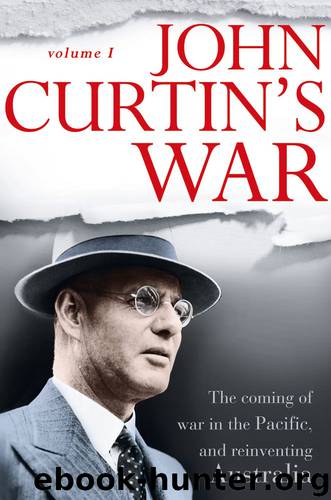
Author:John Edwards
Language: eng
Format: epub
Tags: Non-Fiction
ISBN: 9781742537733
Publisher: Penguin Random House Australia
(1)
Japan had moved into Tonkin in 1940 and into southern Indo-China in July 1941. It was threatening to move into Thailand.1 Each move south brought its airfields closer to Malaya. By mid-1941 Churchill wanted Roosevelt to join him in drawing a line against further Japanese advance. With the United States Senate reluctant to go to war, Roosevelt had no intention of joining Churchill in such a public statement. Britain and Australia then had to ponder whether they were prepared to draw a line against Japan without United States support. That would mean war with Japan if it continued the southward advance. But since the British could not send a fleet, or provide sufficient planes to meet even the minimum requirement for the defence of Malaya, or deploy armies of size sufficient to intimidate Japan, it was quite clear that the British Empire could not go to war with Japan without America.2 That was the reality, even if the British Government might pretend otherwise. At this point and long beforehand the United States was deciding strategy towards Japan, and Britain had no choice but to support Washington. Step by step, Roosevelt was preparing for war in the Pacific.
For some years the United States had planned to abandon its position in the Philippines at the outbreak of a war with Japan. In July 1941, US Army Chief of Staff General George Marshall reversed policy, deciding instead to defend the islands. Roosevelt appointed General Douglas MacArthur, then in the Philippines, commander of United States Army Forces in the Far East. He also commanded the Philippines army. Heavy bombers capable of reaching Japan from the Philippines were sent to MacArthur’s new command. Roosevelt’s appointment of MacArthur signalled an intention to meet Japan. So, too, the deployment of the B-17 long-range bombers. To support the new command Australia agreed to construct airfields at Darwin, Townsville, Rabaul and Port Moresby for American planes flying between the Philippines and Hawaii.3
By the time Curtin returned to the eastern states in early August 1941, the threat of war in the Pacific had much increased. Through August and into September Curtin hoped war with Japan would be averted. Attending a War Council meeting in Melbourne on 6 August, Curtin listened as Menzies briefed on Australia’s response to the sanctions imposed by the United States and Britain. Churchill was seeking a joint statement with the United States warning Japan against going into Thailand, Menzies reported, but ‘no clear statement had evolved so far’. Menzies was not pleased with the United States. He ‘could not describe the position as satisfactory’. The United States would not make any statement before the Japanese entered Indo-China but had ‘taken drastic action’ after it. Of course, he added bleakly, it was ‘important to keep in line’ with the United States.4
Menzies supported Churchill’s proposal that the United States should warn Japan. There was a difference in objectives between Britain and Australia which Menzies was slow to see. Churchill would welcome war between Japan and the United States.
Download
This site does not store any files on its server. We only index and link to content provided by other sites. Please contact the content providers to delete copyright contents if any and email us, we'll remove relevant links or contents immediately.
Becoming by Michelle Obama(10032)
Beartown by Fredrik Backman(5767)
The Last Black Unicorn by Tiffany Haddish(5642)
Man's Search for Meaning by Viktor Frankl(4611)
The Book of Joy by Dalai Lama(3996)
The Five People You Meet in Heaven by Mitch Albom(3575)
In a Sunburned Country by Bill Bryson(3548)
The Choice by Edith Eva Eger(3473)
Full Circle by Michael Palin(3455)
The Mamba Mentality by Kobe Bryant(3289)
The Social Psychology of Inequality by Unknown(3039)
Imagine Me by Tahereh Mafi(2972)
Book of Life by Deborah Harkness(2943)
The Checklist Manifesto by Atul Gawande(2863)
Less by Andrew Sean Greer(2700)
A Burst of Light by Audre Lorde(2614)
The Big Twitch by Sean Dooley(2440)
No Room for Small Dreams by Shimon Peres(2372)
Everest the Cruel Way by Joe Tasker(2347)
